A sunny day well into October, my husband and I were in the mood to head out for a picnic and soak up the sun while the autumnal colors and crisp cold weather still eluded Northern Virginia. We decided to start early and visit Leesylvania State Park in Prince William County.
Exiting from I-95, we drove along Neabsco Rd passing the Neabsco Creek Wetlands Reserve, a unique habitat teeming with rich wildlife and rare species of plants. I made a mental note to plan my visit next year. The traffic became sparse on the road lined with old estate houses on one side and green shrubbery on the other. Turning right at the park sign, we encountered thick woods leading to the park entrance. Driving past the visitor center, we navigated a hairpin turn expecting the road to continue with trees on either side. Lo and behold! The mighty Potomac suddenly came into view on the right side, vast and wide, beneath an imposing railroad bridge that bisects the river at its confluence with Powell’s Creek.

Powell’s Creek railroad bridge crossing the Potomac
The first huge parking lot that comes into view is for boats including a boat launch area for motorized and non-motorized boats. Parking for other vehicles is right around the picnic area that is bordered by the shoreline. The wooded picnic area has plenty of benches, barbecue pits and a play area for children. It was pretty quiet since we arrived early.

Picnic area in the park
The narrow shoreline is right across; although swimming is not allowed one can wade in the waters, sunbathe, take a quiet paddle on the creek or curl up with a book under a tree by the sandy beach.

Powerboats in the river
The History
A walk along the entry road acquaints visitors with the timeline of the park’s rich history dating back to colonial times. Leesylvania is nestled along the tidal shores of the historic Potomac River, flanked by Neabsco Creek on the North and Powell’s Creek on the South. Native Americans lived on this land for thousands of years. Captain John Smith visited the area in 1608 on his voyage of discovery.

View of river across picnic grounds
Leesylvania which means “Lee’s Woods,” was the ancestral home of Virginia’s legendary Lee and Fairfax families. The land, which was patented in 1658, belonged to Henry Lee II and Henry (“Light Horse Harry”) Lee Ill, father of General Robert E. Lee. Locally the area is known as Freestone Point, referring to the sandstone early settlers took from the property for building. The Freestone Fisheries played an important role in Leesylvania’s past. Their successful operation, given the plentiful numbers of fish in the Potomac, provided a significant income to the successive proprietors of the Leesylvania estate. The Lee family conducted business in the fishing industry until they sold the property to Henry Fairfax in 1825.

The fisheries at Freestone Point remained in operation until the end of the nineteenth century. The historical Iron Pulley Wheel found buried here has been preserved as a reminder of the bygone fishing industry in Leesylvania. It likely served to help pull boats and or nets from the river as part of the fishing activity that occurred here for over hundred years. In fact, George Washington described the high quality of the Potomac river fishery as: “A river well-stocked with various kinds of fish at all seasons of the year, and in the spring with shad, herrings, bass, carp, perch, sturgeon, etc. in great abundance … the whole … is one entire fishery.”

Iron Pulley Wheel
In the late 1950s a large scale gambling resort was planned for Freestone Point, termed “Pleasureland of the East”. The original scheme boasted a luxury hotel, a golf course and country club, marinas, white sand beaches, swimming pools, tennis, an amusement park and more. Much of this fourteen million dollar vision was forgotten with the demise of the gambling ship in 1958. Existing facilities were utilized and others added in the early 1960s when the resort was converted in to a recreational area. Featured here were three swimming polls, a ferris wheel, a merry-go-round, go-kart racing, pony rides, a boardwalk and pier, a model train ride, and over mile of white sand beach.

Grand opening Advertisement, May 28, 1960
This 508-acre park was donated to the Commonwealth in 1978 by the noted philanthropist Daniel K. Ludwig and was opened on June 17, 1989.
Walking along the shoreline we came to the universally accessible 300-foot fishing pier where anglers lined the railing to cast their live into the deep Potomac waters. Fishing can be done here both on the pier and by boat with a VA or MD fishing license.

Fishing pier at Leesylvania State Park (Source: funinfairfaxva.com)
This strip of shoreline is perfect for throwing wood for dogs to fetch. We watched in amusement as a frisky dog egged its owner on to throw driftwood into the water and jumping in with delight to bring it back. The shoreline almost came to an end ahead making it impossible to walk any further. We turned back to explore the trail going up the incline to our left.
Civil War Trail
The Lee’s Woods Historic Trail is a part of the Potomac Heritage National Scenic Trail, a moderate two-mile hike through mature woods that is easy-to-follow with the help of purple markings along the way.
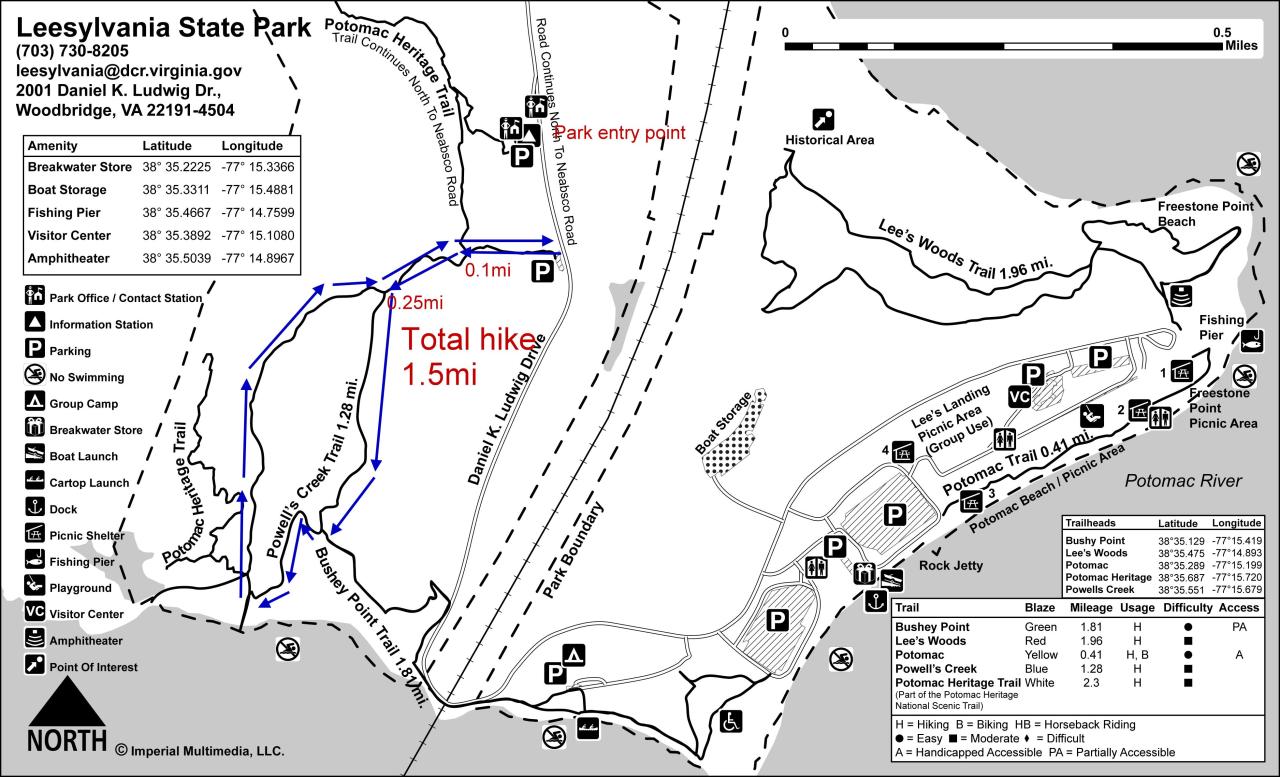
Trail Map
The first viewing point over a bluff offers a distant view of brightly colored houses and the railroad crossing over Neabsco Creek.

Bridge over Neabsco Creek as seen from Lee’s Woods Trail
Further on, the pathway leads to civil war historical ground from where confederate forces commanded a battery of 32-pound cannons. The history is interesting to note.


The Gun Battery preserved at Freestone Point
It is easy to see why Freestone Point was used to blockade the Potomac River. The site lies on a small peninsula jutting into the Potomac offering sweeping views of the river and creeks beyond.

View of the fishing pier and river from Lee’s Woods Trail
The trail continues through the site of Lee’s ancestral home, an old family cemetery and a marker where the Lee Family Garden stood. We turned left where the trail loops downward and passes an old homestead site with a brick and amphitheater. On this site stood the Lodge of the Freestone Point Hunt Club. The two story frame structure was built in the 1920’s by Gordon Wheelock. As duck numbers declined, so did the property’s attraction for hunting. It was sold in the early 1950’s.

Site of Freestone Hunt Club and Amphitheater
A long flight of steps lead back to the trail access point where we started. There are five hiking trails inside the park, including a 20-station fitness trail.

Entrance to Lee’s Woods Historic Trail
Bushey Point Trail
After treating ourselves to a waterfront picnic lunch it was time to check out Bushey Point trail as it was the nearest. A kayak launch area marks the beginning of the trail that branches out to both sides, we turned to the right and followed the path going parallel to the river bank and past a boardwalk, enjoying an unimpeded view of the river.

Boardwalk on the trail
This is a gentle trail offering beautiful views of the bay along Powell’s Creek. The Powell’s Creek Bridge railroad trestle could be seen from afar. The Amtrak and CGX freight trains pass through the bridge. There was a lone tree bursting with deep colors along the way.

Distant view of Powell’s Creek Bridge
The trail continues past the bridge and comes out onto the road to connect to another trail.
Listed on the National Register of Historic Landmarks, Leesylvania offers outdoor activities like hiking, camping, picnicking, fishing and boating. Picnic area rentals, boat launch, boat storage area, snack bar, and canoe and kayak rentals are available. The visitor center has information on park happenings, nature and history exhibits for children and a gift shop. Park entrance fee is $5 per vehicle. The park is also a natural habitat for eagles, hawks, heron, deer, foxes and other wildlife.
The park is busy in summer and we recommend coming in the morning to beat the crowds or in time to catch the sunsets from the fishing pier. A zoom lens will come in handy for clearer distant shots from the trails. A stroll through Bushey Point would be best kept for last after exploring the historic trail. The woods and river views would be charming year round for quiet walks and to spot wildlife.


 beholdnclick
Leave a comment