The anticipation and excitement of “Golu-hopping”, the newfangled term referring to social calls made at festival time, has come to an end as Navaratri draws to a close yet another year. Navaratri or Navarathri, is a Hindu festival celebrated with ardent devotion and religious fervor all over India during autumn. Golu or Bommai Kolu is an essential part of the Navaratri festival in almost every household in the Southern states of Tamil Nadu, Karnataka, and Andhra Pradesh.
Golu is the arrangement of an array of dolls, figurines, and idols on odd-numbered wooden steps designed specifically for the purpose. The Golu is usually kept in the backdrop of a bright saree laid out on the steps. The dolls are akin to sacred heirlooms handed down from one generation to the next, to be displayed artistically while adding to the collection every year.
Nothing is more delightful than looking at such a colorful ensemble through the lens and capturing all of its vibrant hues, with each little doll or artifact with a story to tell. Here I am sharing some interesting pictures I took while Golu-hopping.

A Golu of dolls and statues arranged in rows
The celebratory Golu represents the victory of Goddess Durga over Mahishasura, a wicked demon in the form of half buffalo (Mahisha) and half Asura (demon), by engaging him in battle for nine days and eventually killing him on the tenth day. The tenth day is celebrated as Vijayadashami signifying “Vijaya” or victory of good over evil. The word Navaratri, literally meaning nine nights, is observed to invoke the power of the divine feminine or various avatars of Hindu Goddesses.
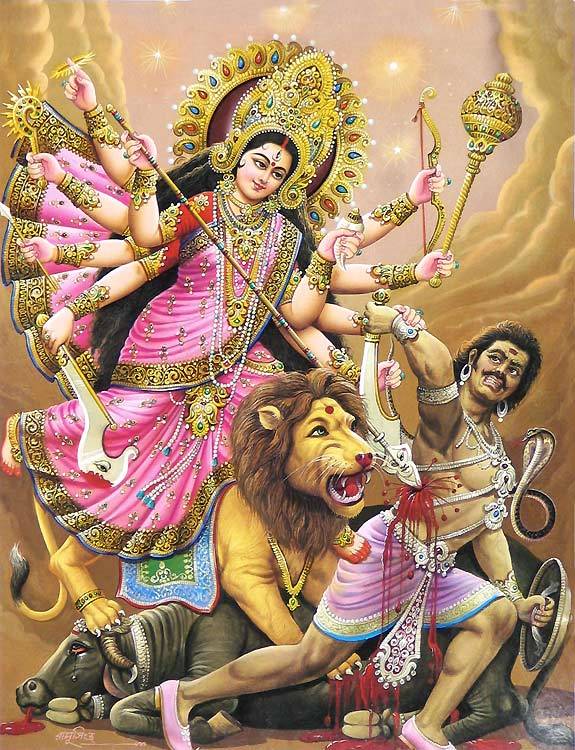
The iconic picture of Goddess Durga riding her lion and attacking Mahishasura. Source: sakti.it
It is believed that Golu is a representation of the assembly of all Gods and Devas who came down from Devaloka to witness the ferocious battle as it unfolded. Apart from folklore, the more plausible explanation behind the origin of displaying dolls as a festival tradition, might have been to help local farmers and artisans make a living by selling their handmade clay goods.
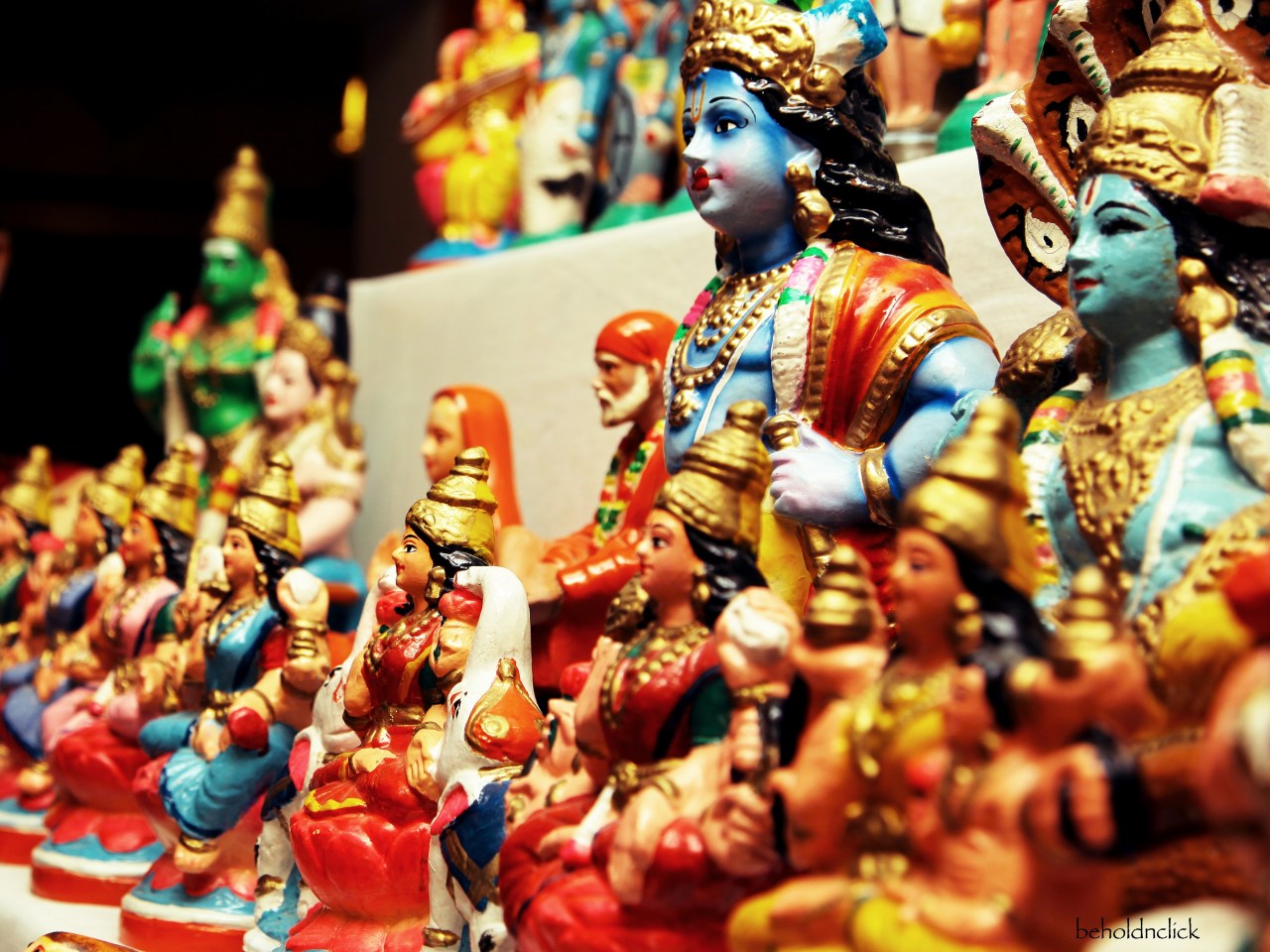
An imposing statue of Lord Krishna behind small clay dolls making up the “Ashtalakshmi” set or eight avatars of Goddess Lakshmi
The “Marapachi” or wooden doll is a must-have in all Golu displays and the collection of other dolls is built around it. Marapchi is a pair of statuettes of a man and woman, made out of red sandalwood, shown as married to each other, adorned in colorful zari costumes and accessories.

A set of decked up “Marapachi” dolls amidst a Golu arrangement
Brightly painted idols and dolls made of clay, terra-cotta, wood, and papier-mache of various shapes and sizes narrate stories from mythology, depict scenes from mundane life or acquaint the viewer with famous places and personalities.
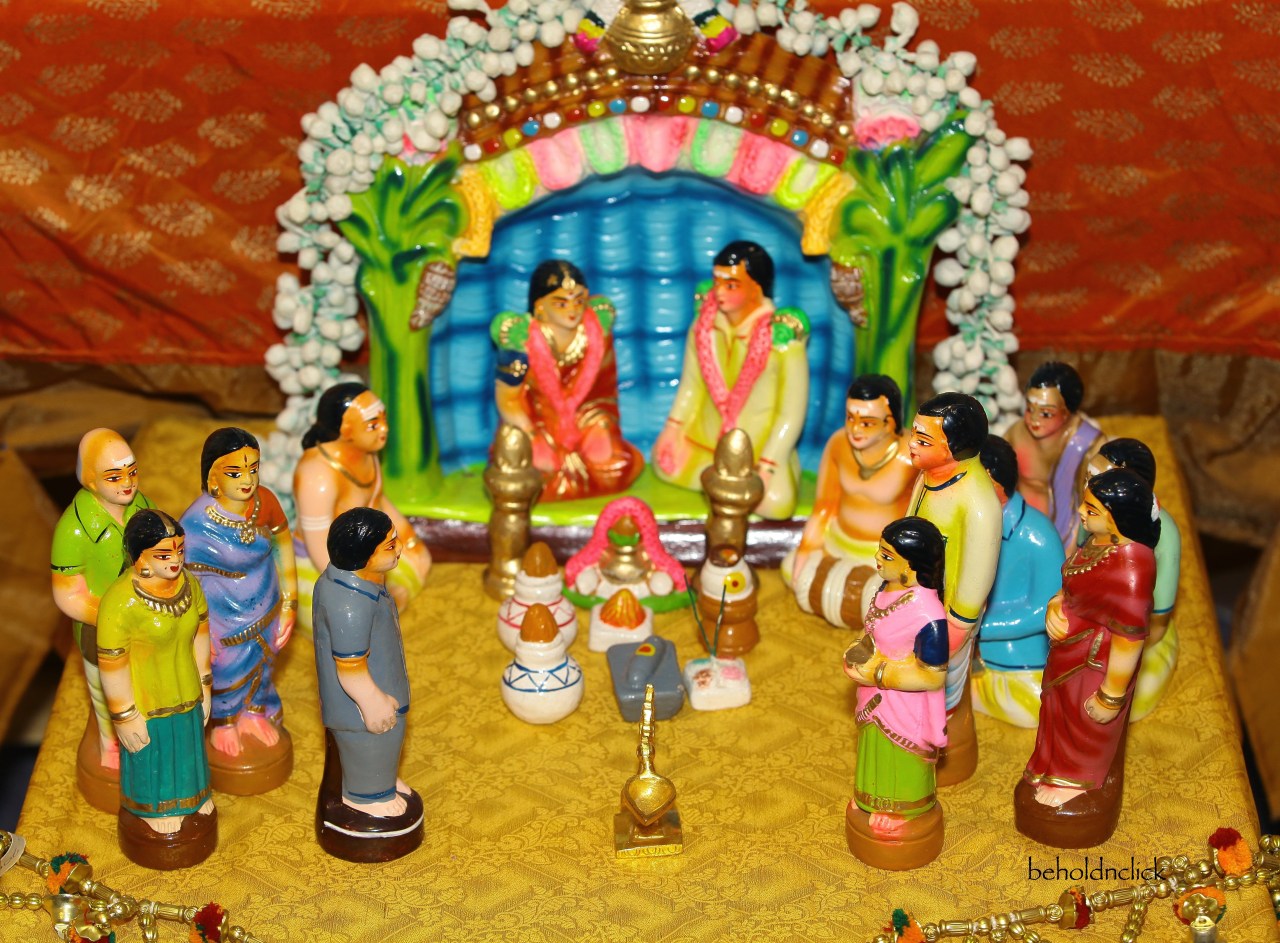
A scene from a Hindu marriage – Guests look on as the bride and groom are seated on the “mandapam” (altar), a Hindu priest recites mantras, and musicians play the mridangam, a traditional Indian musical instrument.

Eminent personalities who shaped Indian history, (from left) Jawaharlal Nehru, Mahatma Gandhi, Swami Vivekananda, and Indra Gandhi

The Trinity of Carnatic music, Syama Sastri, Thyagaraja Swamy, and Muthuswami Dikshitar, the outstanding trio of composer-musicians of Carnatic music in the 18th century
While Golus in the past gracefully featured the collection in a traditional manner, the present day Golu has grown to an elaborate annual exhibition to showcase prized possessions and creativity at displaying them. The conventional tiered arrangement is complemented with a melange of artifacts placed according to unique themes, ranging from history of centuries-old temples, and mythological tales to social issues like ‘Going Green’, ‘Protecting the environment’, and so on.
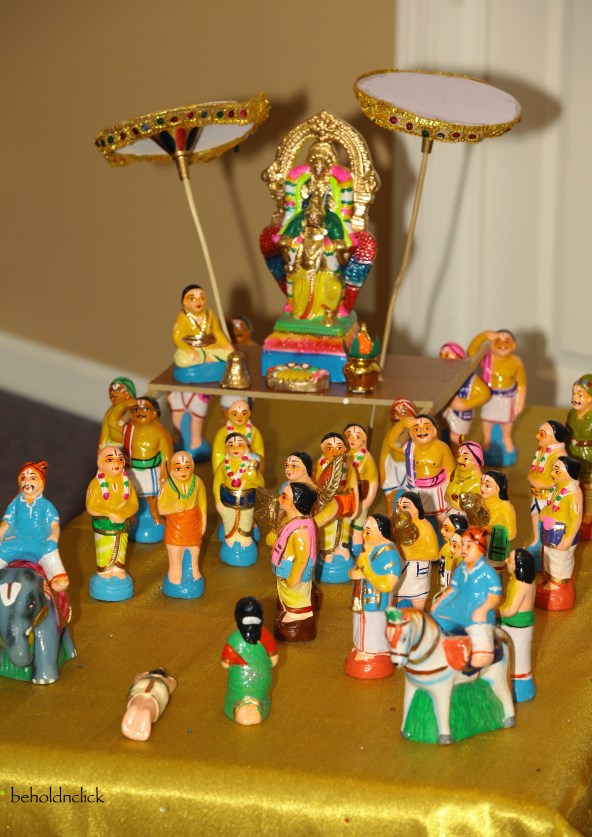
Devotees prostrate before the deity at a temple procession. Lord Vishnu is carried on a palanquin accompanied by temple priests
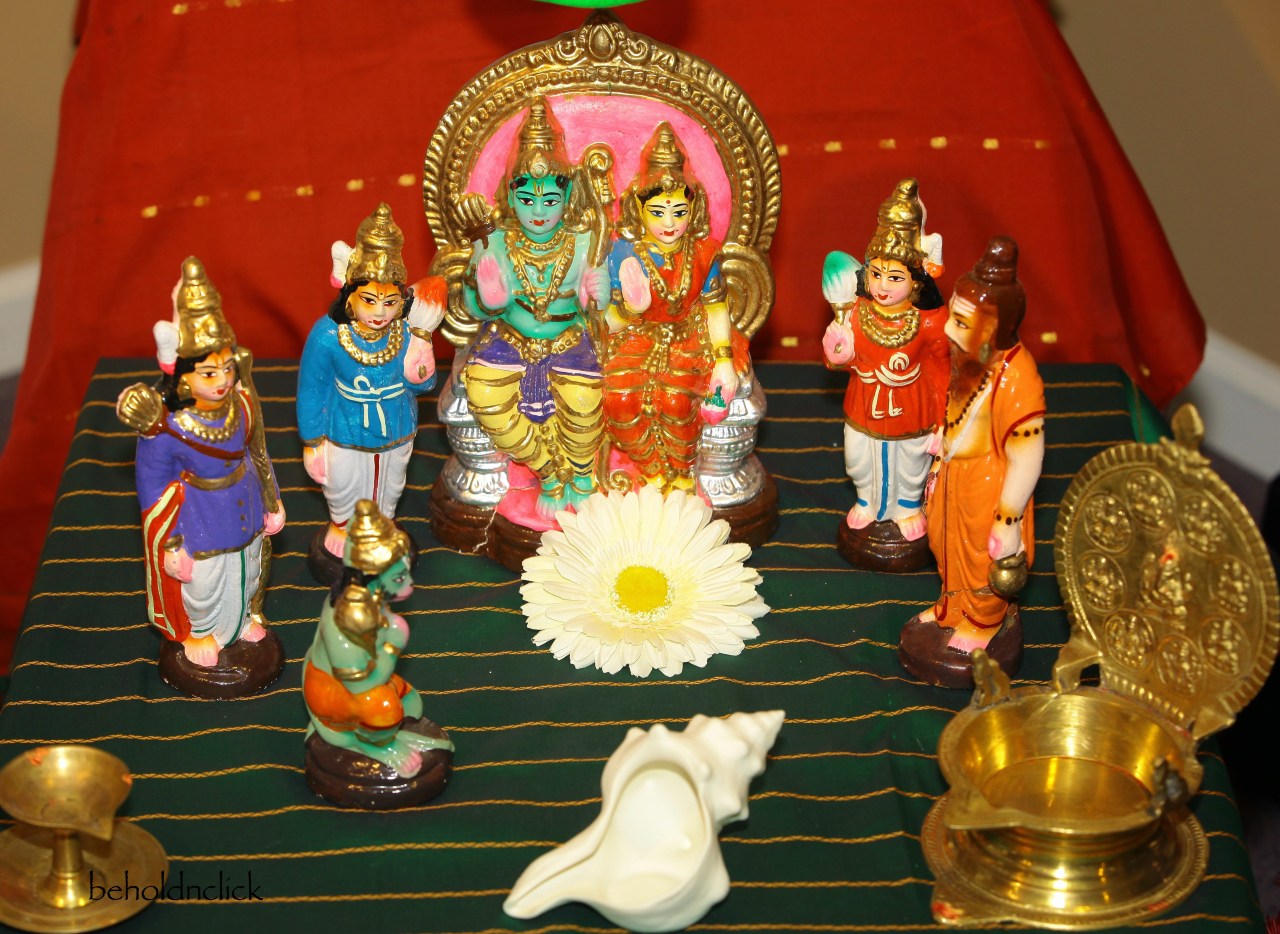
“Pattabhishekam” (coronation ceremony) of Lord Rama, with his beloved Sita seated by his side on the throne, an important episode from the Ramayana
Toys, lego creations, travel souvenirs, dainty pottery, miniature kitchen utensils, and just about anything that is aesthetically appealing find their place in the hotchpotch of Golu nowadays.

“Guhan Odam”, a scene from the Ramayana. Here, Guhan helps Lord Rama, Sita and Lakshman to cross the River Ganga in his boat (odam).
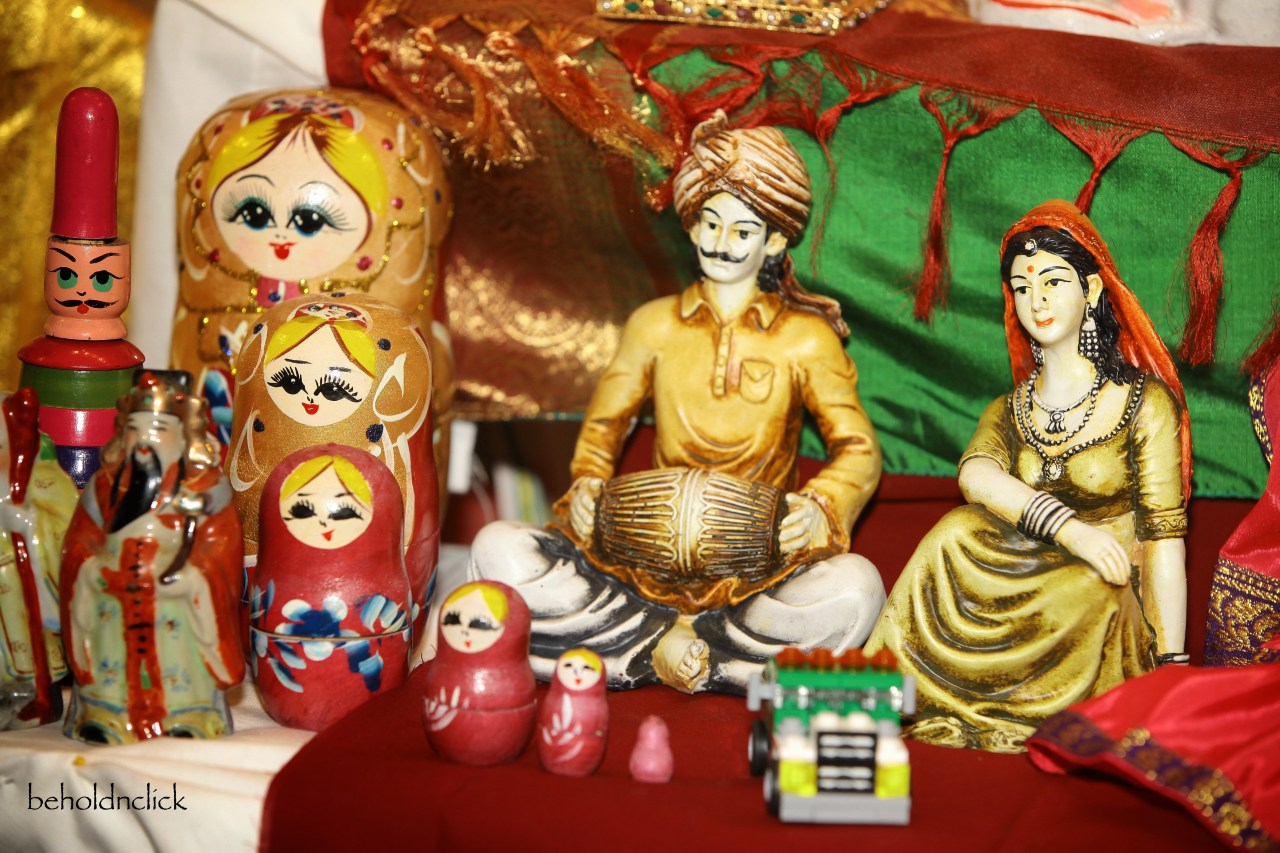
Matryoshka (Russian dolls) of decreasing size and figurines of Rajasthani singers
During the nine days of Golu, dishes made out of lentils or pulses, known as “sundal” is offered to the Goddess. Family and friends are invited to view each other’s Golu and take part in special prayers, singing, or playing musical instruments as an offering to Saraswathi, the Goddess of education and learning. On the evening of Vijayadashami, any one doll in the array is symbolically put to sleep to mark the end of that year’s Golu. The delicate dolls are then carefully packed and put away in storage, where they await their nine days of glory until next year.
Needless to say, much contemplation and research goes into planning the intricate set up of dolls, such as coming up with a distinctive theme, depicting it with interesting stories, as well as collecting and shopping for suitable figurines. Creating a Golu is indeed an art by itself that entails passion, creativity, patience, and commitment to perform it anew each year with differing, meaningful perspectives.
Glossary of Terms
-
Asuras are mythological lord beings in Indian texts who compete for power with the more benevolent Devas (also known as suras). Asuras are described in Indian texts as powerful superhuman demigods or demons with good or bad qualities. (Source: Wikipedia)
-
Devas means “heavenly, divine, anything of excellence”, and is also one of the terms for a deity in Hinduism. Deva is masculine, and the related feminine equivalent is Devi (pronounced Devee). (Source:Wikipedia)
-
Devaloka – In Indian religions, a devaloka or deva loka is a plane of existence where gods and devas exist. The deva lokas are usually described as places of eternal light and goodness, similar to the concept of Heaven. (Source: Wikipedia)
-
Zari (or Jari) is an even thread traditionally made of fine gold or silver used in traditional Bengali, Indian, and Pakistani garments, especially as brocade in saris etc. This thread is woven into fabrics, primarily made of silk to create intricate patterns. (Source: Wikipedia)



 beholdnclick
Leave a comment